Mulch Calculator: How Much Do You Need?
On this page
Measure the bed, get the amount
Pick rectangle, circle or several rectangles, enter feet, and set the depth. The result shows cubic feet, cubic yards and the number of bags, with the arithmetic underneath so you can check it. Switch to pine straw to get bales instead.
How much you need
Pick a shape, enter the size and depth. You get cubic feet, cubic yards and bags, or pine straw bales.
Gear to look at
As an Amazon Associate, Aberdeen Florist earns from qualifying purchases. Disclosure
How the math works
Volume is area times depth. Area in square feet times depth in inches, divided by 12, gives cubic feet. Divide square feet times inches by 324 and you get cubic yards, because a cubic yard is 27 cubic feet and 27 times 12 is 324. UF/IFAS gives the same rule and the same worked example: 128.5 square feet at 3 inches needs about 1.2 cubic yards.
For a circle, the area is the radius times the radius times 3.14, and the tool uses the width across, so you can measure with a tape and not halve anything. For an oddly shaped bed, split it into rectangles and circles and add the areas, or enter the rectangles one after another in the several-rectangles option.
Handy gear on Amazon
SponsoredAs an Amazon Associate, Aberdeen Florist earns from qualifying purchases. See our affiliate disclosure.
DWALE Driveway Fabric,13x115 ft Road Fabric Commercial Weed Barrier Fabric, Landscape Fabric Heavy Duty 5OZ French Drain Fabric for Erosion Control,Landscape Fabric,Weed Barrier,Construction Projects
$119.99$95.99
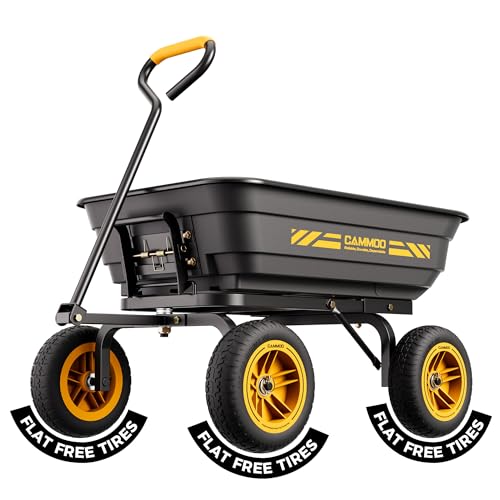
View on Amazon (DWALE Driveway Fabric,13x115 ft Road Fabric Commercial Weed Barrier Fabric, Landscape Fabric Heavy Duty 5OZ French Drain Fabric for Erosion Control,Landscape Fabric,Weed Barrier,Construction Projects)CAMMOO 10-in NO-Flat Tires 600lb Garden Dump Cart 4 Cu.Ft Wheelbarrow Black | Garden Wagon Quick-Release Dumping Garden Cart Virgin Polypropylene - Not Recycled Material for Landscaping Gardening
$129.99$84.99
View on Amazon (CAMMOO 10-in NO-Flat Tires 600lb Garden Dump Cart 4 Cu.Ft Wheelbarrow Black | Garden Wagon Quick-Release Dumping Garden Cart Virgin Polypropylene - Not Recycled Material for Landscaping Gardening)Adjustable Metal Leaf Rake Long Handle, Garden Rakes for Lawns Heavy Duty Leaves with Expandable Head 8-17", Yard Women Kids Rake for Gardening RV Camping
$21.99$17.59
View on Amazon (Adjustable Metal Leaf Rake Long Handle, Garden Rakes for Lawns Heavy Duty Leaves with Expandable Head 8-17", Yard Women Kids Rake for Gardening RV Camping)Sunocity 6ft x300ft Black Weed Barrier 3.5oz Landscape Premium Fabric-Heavy Duty Woven Ground Cloth with Superior Permeability Weed Control Convenient Design
$75.59
View on Amazon (Sunocity 6ft x300ft Black Weed Barrier 3.5oz Landscape Premium Fabric-Heavy Duty Woven Ground Cloth with Superior Permeability Weed Control Convenient Design)Garden Rake, 63 Inch Long Handle with 17 Tines, Heavy Duty Metal Bow Rake for Loosening Leveling Soil, Garden Leaf Rake for Raking Leaves Grass , Weeding, Metal Yard Thatch Lawn Care Garden Tool
$23.99
View on Amazon (Garden Rake, 63 Inch Long Handle with 17 Tines, Heavy Duty Metal Bow Rake for Loosening Leveling Soil, Garden Leaf Rake for Raking Leaves Grass , Weeding, Metal Yard Thatch Lawn Care Garden Tool)iropro Weed Barrier Fabric Heavy Duty 6ft x 300ft Landscape Fabric | 3.2oz Woven Weed Control Fabric, Water Permeable Weed Block Fabric, For Garden, Flower Beds, Driveways & Landscaping
$65.99
View on Amazon (iropro Weed Barrier Fabric Heavy Duty 6ft x 300ft Landscape Fabric | 3.2oz Woven Weed Control Fabric, Water Permeable Weed Block Fabric, For Garden, Flower Beds, Driveways & Landscaping)Brut Organic Aspen Mulch 10 QT – Natural Moisture Retainer & Root Protector – Odor-Free, Nutrient-Rich Bark Mulch for Landscaping, Garden Beds & Potted Plants
$24.99
View on Amazon (Brut Organic Aspen Mulch 10 QT – Natural Moisture Retainer & Root Protector – Odor-Free, Nutrient-Rich Bark Mulch for Landscaping, Garden Beds & Potted Plants)Back to the Roots Organic Mulch for Landscaping and Gardens, 1 Cubic Foot | Premium organic garden mulch for plants, vegetable gardens, raised beds, flower beds and trees; peat-free; 25.7 quart bag
$28.99
View on Amazon (Back to the Roots Organic Mulch for Landscaping and Gardens, 1 Cubic Foot | Premium organic garden mulch for plants, vegetable gardens, raised beds, flower beds and trees; peat-free; 25.7 quart bag)




Prices and availability were accurate when retrieved from Amazon and may change. Retrieved Nov 25, 2026.
How deep should mulch be?
UF/IFAS recommends mulching to 3 inches, and only 1 inch around seedlings, small vegetables and herbs so growth is not held back. Deeper is not better: the depth you enter is the depth that lands in your result, so a 4-inch layer asks for a third more than a 3-inch one.
| Depth | One cubic yard | One 2 cubic foot bag | One 3 cubic foot bag |
|---|---|---|---|
| 1 inch | 324 sq ft | 24 sq ft | 36 sq ft |
| 2 inches | 162 sq ft | 12 sq ft | 18 sq ft |
| 3 inches | 108 sq ft | 8 sq ft | 12 sq ft |
| 4 inches | 81 sq ft | 6 sq ft | 9 sq ft |
Mulch or pine straw?
Pine straw is sold in bales by weight and mulch by volume, so the two do not compare one to one. The table puts the sourced facts next to each other, and leaves a blank where the sources say nothing.
| What | Mulch | Pine straw |
|---|---|---|
| Depth | 3 inches; 1 inch around seedlings, small vegetables and herbs (UF/IFAS Gardening Solutions: Choosing and Installing Mulches) | An initial 3-inch layer for shrubs and trees, a little less on bedding plants, roses and perennials (LSU AgCenter: Pine straw makes excellent mulch (2009)) |
| Sold by | Volume: cubic yards (27 cubic feet) and cubic feet | Bales. Most Louisiana bales weigh 25 to 51 pounds and hold 3 to 6 cubic feet (LSU AgCenter: Pine straw makes excellent mulch (2009)) |
| What it covers | A cubic yard covers 108 sq ft at 3 inches (UF/IFAS Gardening Solutions: Choosing and Installing Mulches) | A 25 pound bale covers 50 sq ft at 3 inches (LSU AgCenter: Pine straw makes excellent mulch (2009)); a 40 pound bale covers about 100 sq ft at 2 inches (NC State Extension, Lee County: Pine Needle Mulch, the Myths and Legends) |
| Topping up | not stated in these sources | Reapply once or twice a year (LSU AgCenter: Pine straw makes excellent mulch (2009)) |
Neither source gives a bale volume that works for pine straw (bales are compressed), so the calculator scales by weight. We assume coverage scales in proportion to depth; neither source says so.
Why pine straw gets a range
LSU AgCenter says half a pound of pine straw per square foot gives a 3-inch layer, and that a 25 pound bale covers 50 square feet at that depth. NC State Extension, quoting Texas AgriLife, says a 40 pound bale covers about 100 square feet at 2 inches. Put those on the same footing, pounds per square foot per inch of depth, and they come out near 0.17 and 0.20. The calculator uses both and shows low and high. Read the weight printed on your own bale: sellers' bales vary from 25 to 51 pounds.
Sources: UF/IFAS Gardening Solutions: Choosing and Installing Mulches (checked 2026-11-25); LSU AgCenter: Pine straw makes excellent mulch (2009) (checked 2026-11-25); NC State Extension, Lee County: Pine Needle Mulch, the Myths and Legends (checked 2026-11-25).
Questions
How many square feet does a cubic yard of mulch cover?
108 square feet at 3 inches deep, 324 square feet at 1 inch, according to UF/IFAS.
How do I work out cubic yards of mulch?
Multiply the bed's square feet by the depth in inches and divide by 324. For a circle, multiply the radius by itself and by 3.14 first. UF/IFAS gives the same method.
How many bags of mulch do I need?
Divide the cubic feet you need by the bag size, and round up. The calculator does this for 2 and 3 cubic foot bags. A bed of 100 square feet at 3 inches needs 25 cubic feet.
How many bales of pine straw cover 100 square feet?
It depends on depth and bale weight. At 2 to 3 inches, the two extension sources point to roughly 1 to 3 bales of 25 to 40 pounds. The calculator shows the range for your depth and bale size.
How deep should I spread mulch?
UF/IFAS recommends 3 inches, and 1 inch around seedlings, small vegetables and herbs.